
Introduction
Most growing businesses do not struggle because they lack data. They struggle because their data is scattered across too many systems.
Product information may sit in spreadsheets. Customer data may live in CRM tools. Digital assets may remain in folders or DAM platforms. Inventory sits in WMS, while finance and operations depend on ERP. Meanwhile, eCommerce teams must keep product pages, pricing, availability, and experience consistent.
When these systems do not talk to each other, decisions slow down, teams duplicate work, and customer experience becomes inconsistent. This is where enterprise integration and data modernization become business-critical.
To put simply, enterprise integration is the process of linking applications, data and workflow across an entire organization. Data modernization, meanwhile, refers to ensuring that this data is both clean and governable. Together, they allow technology leaders to develop a more integrated and scalable organizational design. For many technology executives, enterprise application integration is the initial phase of developing a cleaner, scalable and AI ready data environment.
Quick Answer: What is enterprise application integration and data modernization?
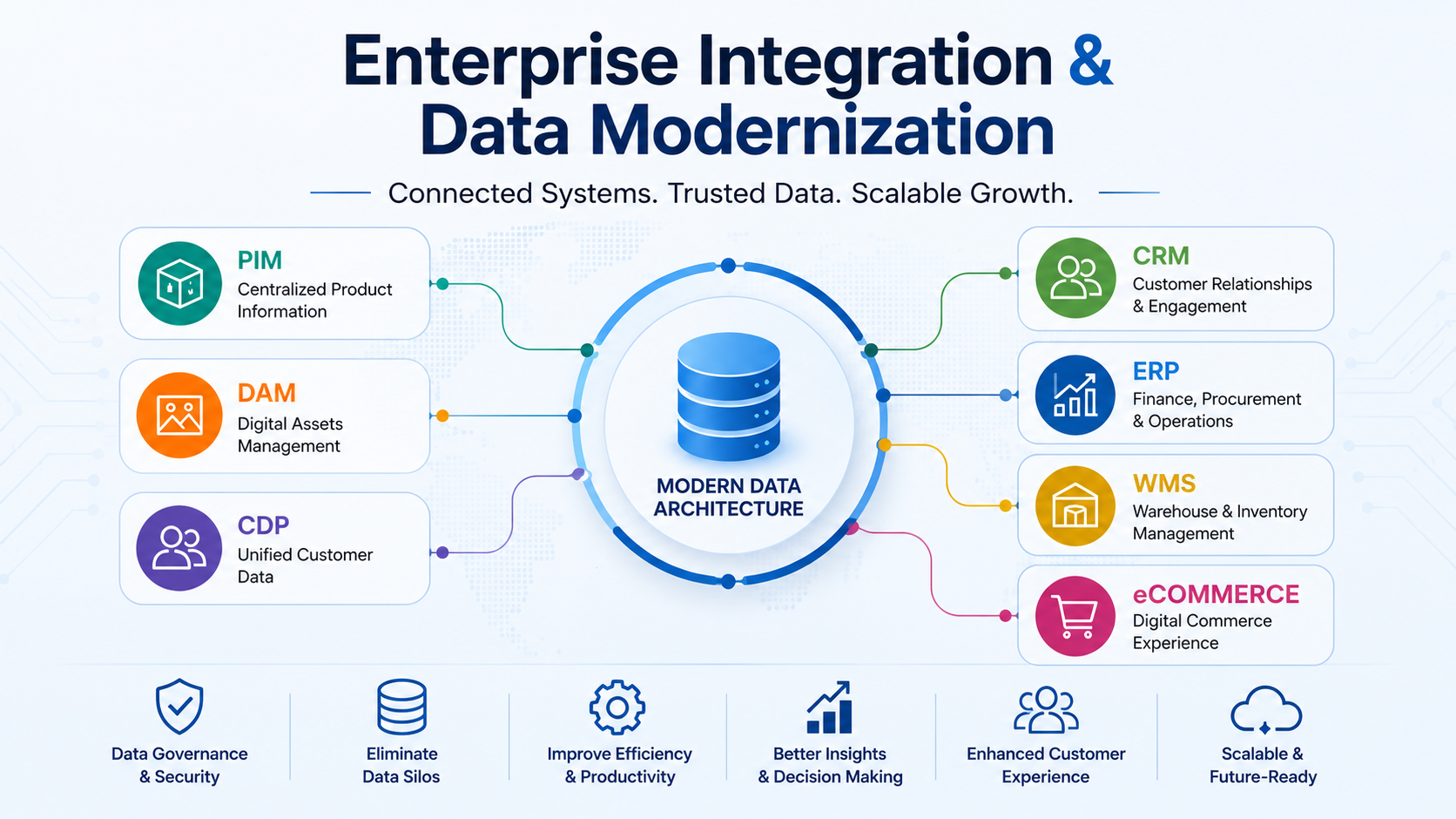
Enterprise integration and data modernization provide organizations with a way to link applications, data, workflow and platforms across an organization so that information can travel efficiently throughout the company. From a technology leader’s standpoint, this equates to minimizing fragmented systems, removing reliance on spreadsheets for workflows, improving data governance and developing a modern data architecture for storing PIM, DAM, CDP, CRM, ERP, WMS, and ecommerce system data together.
Why Fragmented Systems Slow Business Growth
Fragmented systems generate hidden costs. Initially, teams often rely on spreadsheets, manual upload/download processes, shared folders and/or custom workarounds to get the job done. However, once a business expands to a larger scope, those workarounds become bottlenecks.
Disconnected systems result in delays in product launches, incorrect product listings on websites, duplication of effort in entering data, low-quality reports, misaligned inventory levels, inconsistencies in customer experiences and an increased dependence on manual processing.
Every single business function stops working properly during handoffs. Developing an effective enterprise application integration plan eliminates these silos by providing a mechanism for all major platforms to communicate with each other. Additionally, this provides technology teams with a solid foundation to AI-enable future business workflows.
How PIM, DAM, CDP, CRM, ERP, WMS and ecommerce work together
A connected enterprise architecture is most productive when each system performs its designated function.
- PIM stores centralized product names/descriptions/specifications/categories/attributes.
- DAM stores approved product images/videos/catalogs/, and brand assets.
- CDP unites customer data from disparate marketing channels.
- CRM handles leads/opportunities/customer relationships.
- ERP enables communication between finance, procurement, inventory, and billing/operations.
- WMS facilitates warehouse/fulfillment visibility.
- Ecommerce platforms provide customer facing experiences for products.
When all of these systems communicate with each other, product data from PIM can seamlessly transfer into ecommerce. Product images approved via DAM can be used in campaign material/product pages. Insights regarding customers from CDP/CRM can enhance personalization.
This is where Pimcore begins to emerge as a viable solution for commerce led and product led businesses. Pimcore brings capabilities such as PIM, MDM, DAM, CDP, digital experience, and commerce into a unified ecosystem, helping businesses manage product, customer, asset, and experience data more effectively.
Why modern integration must include APIs, Events and Hybrid Cloud Readiness
Modern integration is more than merely connecting two systems. It includes establishing a framework wherein data can flow rapidly, securely and consistently among multiple systems.
As such, technology leaders should consider the following for modern integration:
- API-based connectivity
- Event driven architectures
- Hybrid cloud integration
- Reusable integration flows
- Centralized monitoring
- Access control/governance
- Scalable integration platforms
There is reason for this to be considered because organizations today operate across multiple cloud platforms, on-premise systems, SaaS applications, marketplaces, mobile apps, and customer-facing portals.
Weaknesses in the integration layer will negatively impact every new business initiative.
Manual Spreadsheets vs Governed Data Platforms
Spreadsheets are useful for small teams and temporary tracking. But they are not designed for complex enterprise data management.
A spreadsheet may work for 50 products. But what happens with 50,000 SKUs, multiple languages, dealer networks, marketplaces, regional pricing, and thousands of assets?
| Area | Spreadsheet Approach | Governed Platform Approach |
|---|---|---|
| Accuracy | Error-prone | Validation-led |
| Ownership | Unclear | Defined roles |
| Updates | Manual | Workflow-based |
| Scalability | Limited | Enterprise-ready |
| Audit Trail | Weak | Trackable |
| Integration | Difficult | API/platform-enabled |
| Governance | Informal | Policy-driven |
This is why data modernization services should not be viewed as a migration exercise only. The real value comes from creating governed systems where data has ownership, validation, workflow, security, and integration.
How does data modernization support AI ready growth
AI, automation and analytics are only as good as the data they are built upon. If enterprise data is outdated, duplicated, incomplete, or trapped in disconnected systems, then AI models cannot produce actionable insights.
A modern data foundation enables:
- Real-time analytics
- AI enabled personalization
- Predictive inventory management
- Customer segmentation
- Automated workflows
- Faster reporting
- Better product recommendation
- Stronger regulatory readiness
Therefore, enterprise data modernization is more than just an operational improvement. It establishes the business for AI enabled decision-making and scalable Digital growth.
Business outcomes of enterprise wide integration and data modernization
Retail/ecommerce organizations can use integration that can reduce product launch timelines and minimize errors in content delivery. Manufacturing organizations using integration can improve inventory visibility between ERP,WMS,dealerportal and PIM catalogs. B2B organizations using integration can improve service/reporting by sharing customer contexts between CRMS/CDPS/support/compliance systems.
Additionally, the results of integrating enterprise wide data systems include:
- Reduced time-to-market
- Improved customer experience
- Less manual processing effort required
- Stronger data governance
- Cleaner reporting
- Increased scalability of Digital growth
A connected data foundation enables technology leaders to transition from reactive problem solving to proactively enabling business success.
6 step road map for technology Leaders
A successful data modernization services journey can begin with six phases:
- Assess existing systems: Determine what products/customer assets/inventories/etc. are contained in which systems/applications/processes etc.
- Identify fragmentation: Locate duplicate entries/manual work-flows/spreadsheet dependent processes.
- Prioritize use case(s): Begin with product information/ecommerce accuracy/customer information/inventory visibility, etc.
- Establish target architecture: Select api-based/event-driven/ipaas/hybrid/cloud based/integration platform based architecture, etc.
- Migrate/test safely: Validate data flows, access, security, performance, and continuity.
- Monitor/optimize: Monitor errors, data governance, data reliability,scaling etc., over time.
Where does Pimcore fit?
Organizations that deal with product information, customer information, digital assets, and digital commerce can leverage Pimcore to aid in their enterprise data modernization efforts.
Minds Task Technologies represents itself as a provider of Pimcore implementations, IT and consulting services.
For technology decision-makers, the real question is: “How do we create a connected data foundation that improves speed, accuracy, governance, customer experience, and AI readiness?”
Structured Pimcore consulting services and well-planned data modernization services are mechanisms whereby that goal can be achieved.
Conclusion
Enterprise integration and data modernization are imperative components necessary to eliminate fragmentation, remove reliance on spreadsheets, speed up decision-making, and thus scale digital operations.
When PIM, DAM, CDP, CRM, ERP, WMS, and ecommerce systems are linked together, businesses benefit from cleaner data, quicker execution, better governance, a better customer experience and a modern data architecture designed for growth.
Do you want to reduce system fragmentation and modernize your product/customer/commerce data ecosystem?