
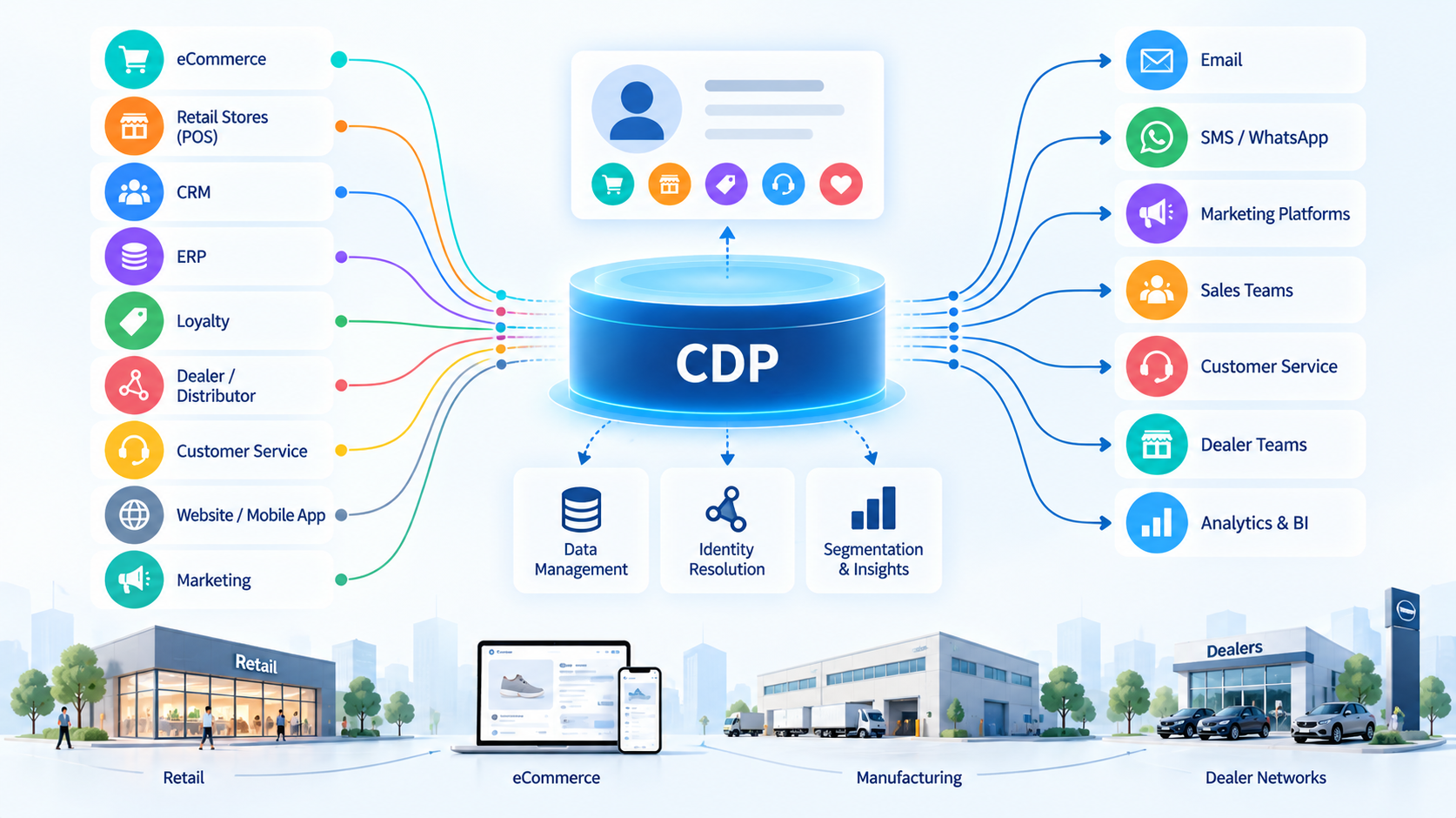
Retailers, e-commerce businesses, manufacturers, and dealer networks have their own ways of collecting customer information. However, most of the time, this type of data is collected separately by each department (e.g., sales, marketing, and customer care teams within the retail operation). As such, businesses can only see partial views of the customer’s purchasing journey, i.e., they don’t have access to all the data that exists.
A customer data platform (CDP) for retail services solves this problem. By creating a single, unified customer view that combines customer, sales, dealer, loyalty and marketing data, retailers, e-commerce sites, manufacturers, and dealer networks can now make informed decisions about which customers to target with which messages, when to reach out to those customers, and why.
The Real Data Problem in Retail
Retail businesses generate a lot of data; however, that data is often disconnected across departments.
As long as none of this information is combined into one source, the company will never be able to make a decision based on complete context.
The lack of connection among customer data can lead to:
- Duplicate customer records
- Generic marketing campaigns
- Poor segmentation
- Missed repeat-purchase opportunities
- Poor dealer insight
- Inadequate journey-based analysis (the path that a customer takes)
- Poor visibility across stores, dealers, and digital channels
Using a customer data platform for retail allows a retailer to create a connected layer of customer intelligence. A CDP does not ask each team to try to make sense of different data sources separately. Rather, a CDP provides all members of the organization with a common view of their customers.
For manufacturers and brands that sell through distributors and dealers, the same problem can extend across the entire customer and sales network. Customer, product, dealer, transaction, service, warranty, and marketing information may sit in separate systems, making it difficult for the manufacturer to understand the complete customer relationship.
How a CDP Strengthens Retail and eCommerce Journeys
A customer data platform for ecommerce is more than just capturing purchase information, like order history or abandoned cart events. A CDP captures relevant online customer behavior and ties together customers’ browse history, their activities in cart, their purchasing behaviors, how they respond to campaigns, their service history, and any offline interactions with the company.
For example, an eCommerce platform may show that a customer abandoned a cart. A CDP can add more context: the customer is a repeat buyer, browsed a premium product category, visited a store last month, and contacted support recently. That changes the next action.
For a manufacturer or brand, the same customer may also have purchased a product through a dealer. Connecting the online activity with dealer purchase and service information can provide a more complete view of the customer and product lifecycle.
Why Dealer Networks Need CDP Thinking
The dealer network does much more than simply act as a point of sale; it influences product selection, builds customer confidence and loyalty, supports post-purchase service needs, creates opportunities for geographic-specific marketing and ultimately drives the overall success of the business.
An end-to-end customer data platform for dealer networks can provide insight into:
- which dealers drive repeat purchase behavior,
- which products are most successful at the regional level,
- which customers interacted with which dealers,
- which dealers require support for campaign execution,
- when a customer is due for renewal, upgrade, or cross-sell.
Without these insights, dealer loyalty programs typically become reward schemes that do little to promote real loyalty. A CDP enables organizations to make decisions about who to support within their dealer network, how to personalize their campaigns across regions, and how to link each dealer’s performance directly to customer retention.
CDP for Manufacturers and B2B Customer Engagement
A manufacturer selling through distributors and dealers may have customer and account information spread across CRM, ERP, dealer systems, eCommerce, warranty, service, product registration, and marketing platforms.
A single B2B journey could have one person (e.g., purchasing agent) downloading an online product catalog; another person comparing technical specs of products on your website; a dealer requesting price quotes; and a sales manager updating a CRM record regarding that same account. Without some form of connection to all four activities (as well as other related activities), it would be difficult to determine what level of interest or intent the account has toward making a purchase.
A B2B customer engagement platform focused on B2B customers will link each of those types of behaviors with others (account behavior, buyer behavior, dealer/distributor influence, repeat purchase orders, service requests, responses to campaigns, etc.), allowing teams to focus their efforts on high priority accounts, personalize communications to them, and help identify potential retention opportunities.
For manufacturers, this can also connect the relationship between the end customer, product, dealer, distributor, service history, and future purchase opportunity.
A Practical CDP Data Architecture
A CDP is not simply another database. It needs to connect data from different systems, establish reliable customer identities, and make the resulting information available to the systems and teams that use it.
A typical retail, eCommerce, or dealer network CDP architecture can include:
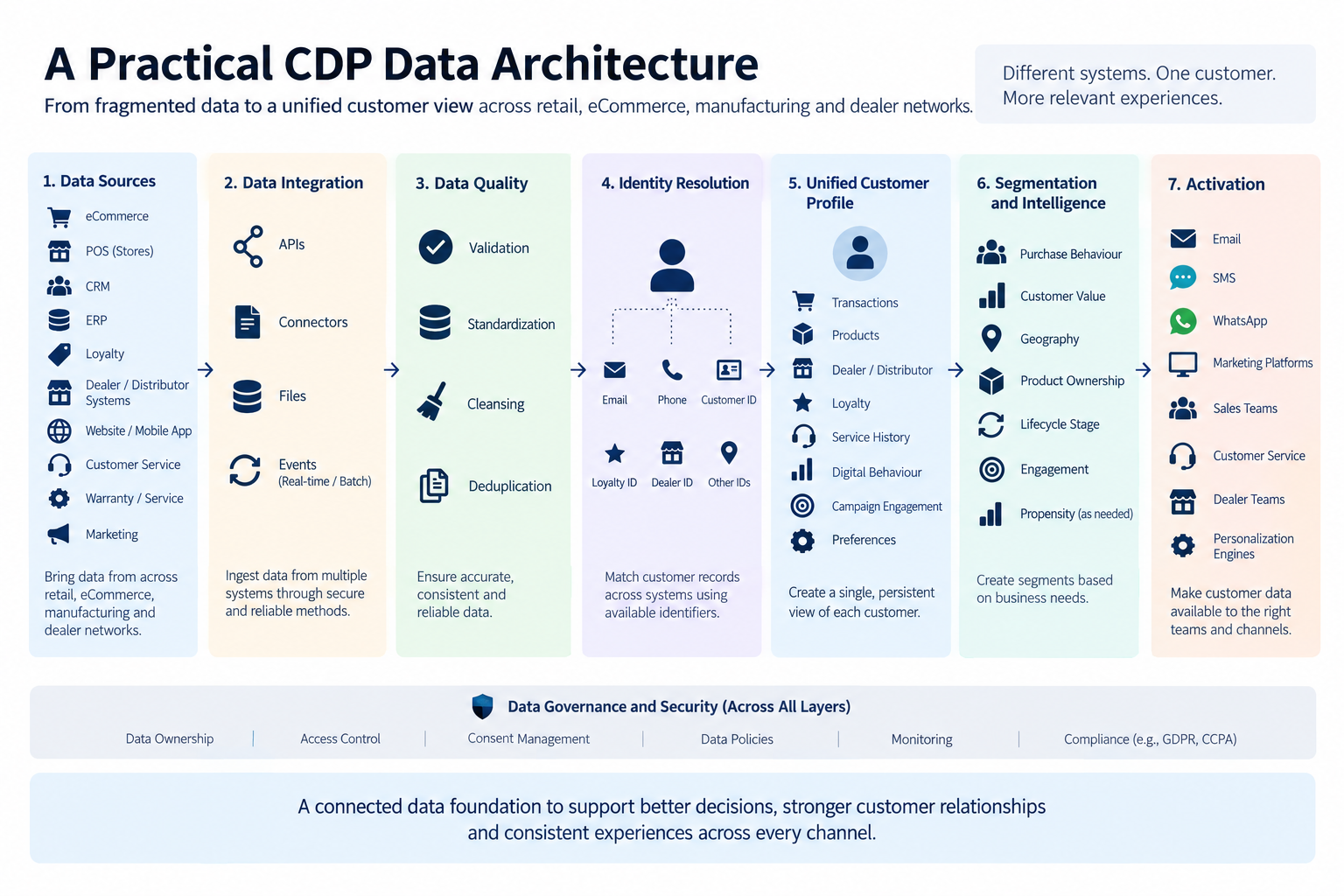
The architecture will vary depending on the business and the systems already in place. The important point is that customer data should be connected in a way that supports the specific business use cases.
A Practical CDP Scenario
Consider a mid-sized electronics brand with an online store, physical retail presence, and regional dealers.
Before implementing a Customer Data Platform (CDP), the mid-size retailer’s e-commerce team was sending abandoned cart emails, its regional dealers were offering their own local deals to customers in-store, and the company’s loyalty team was running promotions. However, none of those efforts was integrated.
For example, a customer could be offered a discount on a product they had already bought from one of the regional dealers. In addition, the company’s loyalty program members received the exact same messages that new visitors to the site did. Also, high-value leads generated by the company’s website were being lost by the company’s sales teams because no relevant information about these individuals ever made it to them.
With a CDP, the brand can build a customer 360 for retail. It can connect online behavior, store purchases, dealer interactions, loyalty status, and campaign response. The result is better action: relevant offers, smarter dealer follow-ups, cleaner segmentation, and more consistent customer experiences.
The same approach can be applied to manufacturers that need to connect dealer sales, customer information, product ownership, warranty, service, and digital engagement.
What Businesses Should Prioritize Before CDP Implementation
A CDP does not start as a technological investment; it starts with a business challenge.
Some of the most common objectives for retailers include developing a singular customer view, integrating online and offline data, enhancing their loyalty programs with dealers, providing personalized experiences on an omni-channel basis, removing duplicate customer information from databases, creating better segmentation models, and correlating marketing initiatives to sales performance and dealer success.
For manufacturers and dealer networks, additional objectives may include connecting distributor and dealer data, linking products with customer records, understanding service and warranty history, and improving visibility into the customer lifecycle after the initial sale.
As soon as each use case is clearly defined by the retailer (as well as other stakeholders), the retailer will be able to determine which data sources to link or integrate into the CDP initially.
A Practical CDP Implementation Roadmap
1. Identify Business Use Cases
Start with the problems the organization wants to solve, such as Customer 360, dealer visibility, customer retention, loyalty, repeat purchases, or personalization.
2. Audit Existing Data
Identify the systems and sources containing customer, product, transaction, dealer, service, and marketing information.
3. Define the Customer Data Model
Determine how customer, account, product, transaction, dealer, service, and engagement records relate to each other.
4. Define Identity Resolution Rules
Determine how customer records from different systems should be matched and how duplicate records should be handled.
5. Integrate Priority Data Sources
Start with the systems required for the selected business use cases rather than attempting to connect every system at once.
6. Improve Data Quality and Governance
Address data quality, standardization, duplication, ownership, access, consent, and ongoing data management.
7. Build the Unified Customer Profile
Create and validate the Customer 360 view using the connected data.
8. Create Customer Segments
Build segments based on customer behavior, product ownership, geography, lifecycle, value, or other business requirements.
9. Connect Activation Channels
Make relevant customer information available to marketing, sales, service, CRM, and dealer teams.
10. Measure and Improve
Track data quality, profile completeness, campaign performance, customer engagement, retention, repeat purchases, and other agreed business measures.
The implementation approach should be based on the organization’s existing technology, data quality, integration requirements, and business priorities.
How Minds Task Technologies Supports CDP Initiatives
Minds Task Technologies provides CDP services covering the areas required to plan, integrate, and implement a customer data environment.
CDP Strategy and Consulting
Assess the existing customer data environment, identify business use cases, and define the CDP strategy and implementation approach.
Data Integration and Migration
Connect relevant CRM, ERP, eCommerce, POS, dealer, distributor, loyalty, service, and marketing systems and support data migration where required.
Customer 360 and Identity Resolution
Bring customer records together, address duplicate records, define identity matching rules, and establish relationships between customers, products, transactions, dealers, and channels.
Data Governance and Quality
Address data ownership, quality, standardization, access, consent, and ongoing data management requirements.
Segmentation and Personalization
Use connected customer data to create relevant customer segments and support personalized engagement across appropriate channels.
CDP Implementation
Support the implementation from data assessment and architecture through integration, migration, Customer 360, segmentation, and activation.
For retail, eCommerce, manufacturers, and dealer driven businesses, the approach can be adapted to the existing systems and customer data structure rather than requiring the organization to replace every existing platform.
Conclusion
Retail, e-commerce, dealership, and manufacturing organizations are already collecting substantial amounts of customer data. The problem lies in transforming disorganized data into cohesive insights.
A Customer Data Platform (CDP) is designed for retailers to integrate all forms of customer and retailer data (sales, loyalty, etc.) into an actionable view. A CDP enables omnichannel personalization, increases loyalty among dealerships, enhances B2B customer interactions, retains customers, and facilitates informed decision making throughout various departments within a company.
For manufacturers and brands working with distributors and dealers, a CDP can also connect customer, product, dealer, transaction, service, warranty, and marketing information to provide a more complete view of the customer lifecycle.
Minds Task Technologies assists businesses that wish to transition their organization’s data management processes toward a CDP by developing and implementing a comprehensive CDP strategy that unifies existing data sources, improves the quality of existing data, and supports customer data for segmentation, personalization, and business use.
Assess Your CDP Readiness
If your retail, e-commerce, manufacturing, or dealer network operation currently relies on separate systems or manual reporting of customer activity, the first step is to understand where the data gaps exist.
Minds Task Technologies can help assess your existing customer data environment, identify integration and identity resolution requirements, and define the priority use cases for a CDP implementation.
Request a CDP Discovery & Readiness Assessment
- Understand your current data sources.
- Identify integration and data quality gaps.
- Prioritize your CDP use cases.
- Define the next steps toward Customer 360.
Start your CDP Discovery & Readiness Assessment
Sources
- https://cdp.com/articles/cdp-for-retail/
- https://algonomy.com/resources/guides/customer-data-platform-explained/
- https://deployteq.com/how-retail-brands-are-using-customer-data-platforms-cdp-to-boost-next-best-offers/
FAQs
How does a CDP help eCommerce businesses?
A CDP for ecommerce links customers’ browsing behavior, cart activity, purchase history, campaign responses, and service histories. This enables companies to provide personalized offers, enhance product suggestions, reduce cart abandonment, and encourage repeat business.
Why is CDP important for dealer networks?
A customer data platform (CDP) for dealer networks provides a link between dealer sales, customer behavior, loyalty data and engagement with marketing campaigns. The use of a CDP will enable dealerships to make their loyalty programs more informed through data and retain more customers.
For manufacturers, it can also provide a connection between dealer activity, customer records, product ownership, service history, and future customer opportunities.
Can a CDP connect manufacturer, distributor, and dealer data?
Yes. A CDP can be designed to connect relevant customer, product, transaction, dealer, distributor, service, and marketing information across different systems. The specific integrations depend on the organization’s existing architecture and business requirements.
How does CDP support omnichannel commerce?
A CDP for omnichannel commerce ties together customer interactions from websites, mobile applications, brick-and-mortar retail locations, dealer outlet locations, emails, short message service (SMS), WhatsApp, pay-per-click advertising, and other services in order to provide brands with a more consistent view of customer activity.
Is CDP useful for B2B customer engagement?
Yes. A CDP can serve as a B2B customer engagement platform. The CDP ties together many different types of B2B customer behaviors such as purchasing account behavior, buyer intent, the influence of the distributor on that purchase, all sales-related activities and engagements, and all marketing campaign engagement.
What data should be integrated into a CDP first?
Businesses should start with the data required for their most important use cases. Depending on the organization, this may include CRM, eCommerce, POS, loyalty, dealer, service, ERP, or marketing data.
It is not always necessary to integrate every system during the first phase.
What is Customer 360?
Customer 360 refers to a connected view of relevant customer information across different systems and channels. A CDP can support Customer 360 by bringing together customer records, transactions, product information, dealer relationships, service history, digital behavior, and marketing engagement.